
Build a calm, effective exam routine
A focused plan can make preparation feel much more manageable.
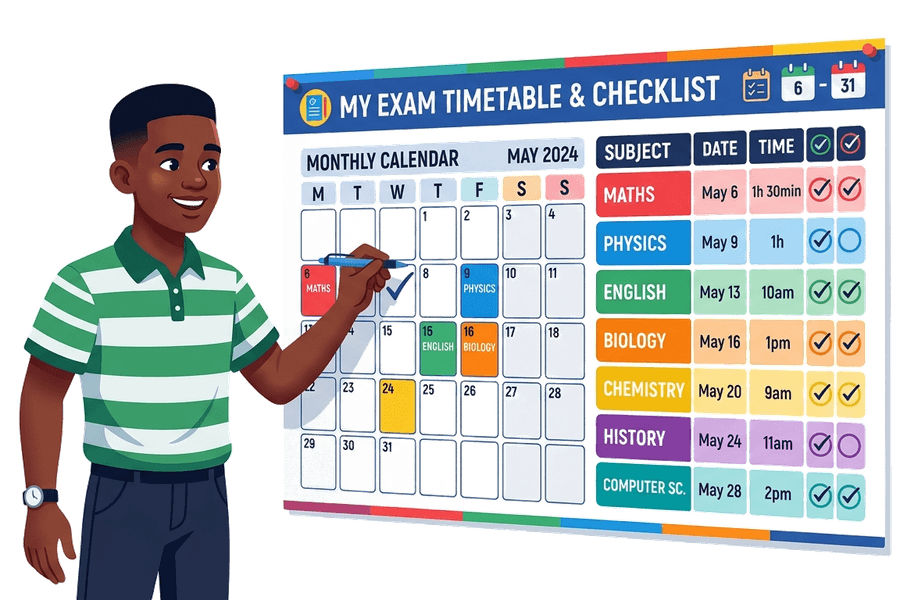
A lot of exam preparation is not really about the syllabus. It is about the hours around it. A student who knows the topics but panics in week one, sleeps badly, and cannot decide what to revise on a given evening will underperform a student with a slightly weaker grasp of the material but a stable routine.
The goal of a routine is not to make you work harder. It is to remove the number of decisions you have to make each day, so that the energy you have left goes into the work itself.
Build backwards from the exam date
Open a calendar and mark the exam day. Now count backwards. You are not trying to fill every day with study, which is how routines collapse. You are identifying:
- Two weeks before, your last full timed paper should already be done.
- One week before, you should be reviewing, not learning new material.
- The last two days should contain no new topics at all.
Writing this down matters more than it sounds. Most of the anxiety in the final fortnight comes from not knowing how much is left, and you cannot know that without a plan.
Fix three anchors, not ten
A routine with fifteen fixed points is a routine that breaks. Pick three anchors and let everything else move around them:
- Wake-up time. Same time every day, including rest days. It fixes your sleep and therefore your study hours.
- One study block. A single block, the same time each day, so it becomes automatic rather than decided.
- Bedtime. Set by when you need to be asleep to wake at your anchor, not by how much you still feel you have left to do.
Everything else in your week is negotiable. These three are not.
Work in 90-minute blocks, not 8-hour days
Long sessions produce low-quality work. Around 90 minutes is roughly the limit for genuinely focused work on new material, after which attention drops and you start re-reading what you have already read.
A good block looks like this: five minutes deciding exactly what you will do, seventy minutes of work with the phone in another room, and fifteen minutes checking and marking your work. A bad block looks like this: six hours at a desk, three hours of scrolling between them.
Two honest blocks a day beat six hours of sitting. Nobody has ever been marked down for stopping while they were still concentrating.
Start with a version you cannot fail
The most common way a routine dies is that it was designed for your best day. Design it for your worst one. If you can only manage two focused sessions on your worst day, then two is your floor, and your plan should assume two. Add more when you have proved you can hold the floor.
A plan you follow on a bad week still moves you forward. A plan you abandon on a bad week resets you to zero.
Give exam week a different routine
In the final week, your body does not want your normal schedule. You are tired, you are anxious, and your sleep is worse. Trying to force a routine designed for a calm fortnight onto a stressed week is how you end up revising nothing in the seven days that matter most.
In exam week: keep the wake time, cut the volume roughly in half, and change what you review. No new material. Only your error log, the formulas you keep forgetting, and the questions you got wrong. Reviewing what you already know feels productive and is not; the time is better spent on the small number of things costing you marks.
Protect sleep like an exam subject
Sleep is when the day’s revision is consolidated. Cutting it to gain two extra study hours is a bad trade: you lose the recall you were trying to build, and you are less alert during the next session. If you can only change one thing, make it a consistent bedtime a week before the exam, not a week of all-nighters.
Movement helps too, and it is the part everyone skips. A twenty-minute walk, some stretching between blocks, or a short session of whatever sport you already play will do more for your next two hours of study than another hour of notes.
Review the routine, not just the syllabus
Once a week, spend fifteen minutes answering three questions: How many sessions did I complete? Which subject got the least time? What did I avoid? That last one is the important one. The topic you keep postponing is usually the topic you are most afraid of, and it is the one worth sitting with while you still have time to fix it.
For the study method underneath the routine, read how to study smarter for JAMB. And if you have not settled which subjects to give the most time, choosing a course and career you will enjoy is a useful place to start, because your subject combination determines what you are even eligible for.